
From Data to Dialogue: Using Solomon’s Insights for IEP Social-Emotional Goals

It's 4:47 PM on a Tuesday. You're sitting in a meeting room with a parent, the school psychologist, and your principal. The parent asks a reasonable question: "Can you show me specific examples of how my child is progressing on their social-emotional IEP goal?"
You flip through your notebook. You remember moments, the time the student took a deep breath instead of yelling, the day they shared a toy without being prompted. But you don't have documentation. You have observations scribbled on sticky notes and half-remembered conversations. The parent crosses their arms. The psychologist raises an eyebrow.
Sound familiar?
Here's the uncomfortable truth: Social-emotional IEP goals are legally required to be measurable, but most teachers don't have the time or tools to measure them consistently. You're expected to track empathy development, conflict resolution, and emotional regulation, the "soft skills" that require nuanced observation, while also managing lesson plans, behavioral incidents, and 28 other students.
Rightfully so, you're exhausted. And you're not alone.
The Documentation Gap in Social-Emotional Learning
According to CASEL (the Collaborative for Academic, Social, and Emotional Learning), effective SEL requires ongoing assessment and reflection. But traditional methods, teacher observation logs, anecdotal notes, and quarterly rating scales, are time-intensive and vulnerable to bias. When an IEP meeting rolls around, you're left scrambling to remember which moments were significant enough to document.
The problem compounds when students need Tier 2 or Tier 3 MTSS interventions. Special education teachers are legally required to show evidence of growth for goals like:
- "Student will identify and express emotions appropriately in 4 out of 5 observed interactions."
- "Student will use a coping strategy before escalating conflict in 80% of triggering situations."
But who's tracking those "observed interactions" in real-time? Who's counting the "triggering situations"? And what qualifies as "appropriate"?
Enter data-driven character education.

How Solomon Turns Reflection Into Evidence
At Wisdom For Kids, we built Solomon, our AI mentor, specifically to solve this problem. Solomon doesn't replace the teacher's judgment; he documents the student's own voice.
Here's how it works:
- The Student Engages with a Story
A student reads or listens to an animated SEL story from our interactive sel curriculum. The story ends with a character-driven dilemma, a moment where empathy, honesty, or self-control matters. - Solomon Asks Reflective Questions
After the story, Solomon (portrayed as wise, not permissive) asks the student open-ended questions:- "Why do you think the character felt that way?"
- "What would you do in that situation?"
- "How could the character have made a better choice?"
- The System Captures Behavioral Data
Every answer the student gives is timestamped, categorized by CASEL competency (Self-Awareness, Self-Management, Social Awareness, Relationship Skills, Responsible Decision-Making), and flagged for concern if needed. - Teachers Get IEP-Ready Insights
Instead of sticky notes, you get a dashboard that shows:- Frequency: How many times did the student demonstrate empathy this month?
- Trend Analysis: Is the student's emotional regulation improving over time?
- Concrete Examples: Specific quotes from the student's reflections that you can copy-paste into IEP progress reports.
This is personalized social emotional learning at scale. It's the 2-sigma advantage of one-on-one mentorship, applied to the most difficult-to-measure part of education.

What This Looks Like in Practice
Let's say you have a third-grader, Marcus, with an IEP goal: "Marcus will identify his emotions and use a coping strategy before acting impulsively in 3 out of 4 opportunities."
In a traditional setting, you'd need to:
- Recognize when Marcus is triggered (often after the fact)
- Document what happened
- Count whether he used a strategy
- Remember to log it before the end of the day
With Solomon, here's what happens instead:
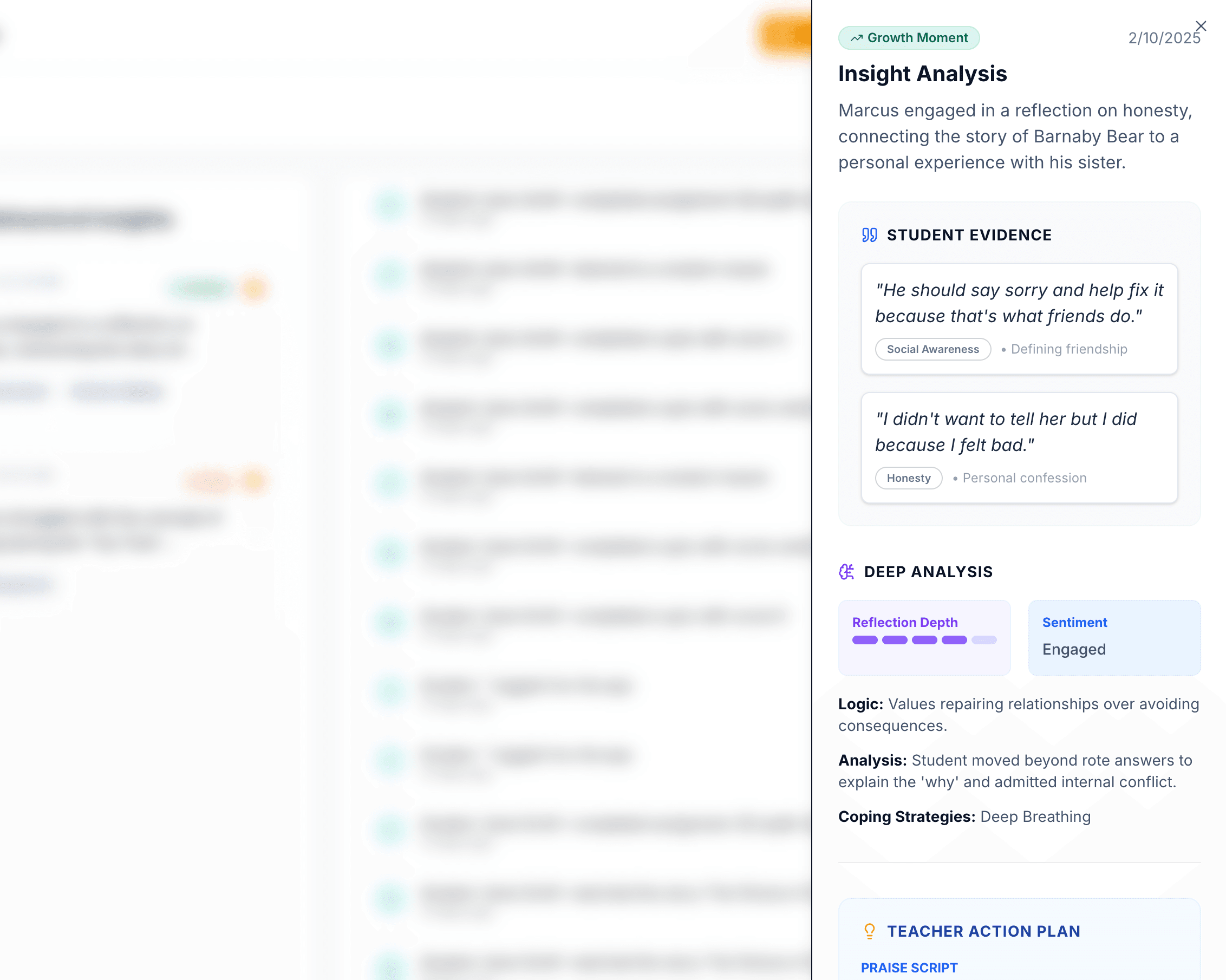
Week 1: Marcus completes the story "Barnaby the Bear at the Bakery," where Barnaby accidentally breaks a friend's toy. Solomon asks: "What do you think Barnaby should do?"
Marcus says: "He should say sorry and help fix it because that's what friends do."
Solomon follows up: "Have you ever had to apologize for a mistake?"
Marcus responds: "Yeah, I broke my sister's crayon and I didn't want to tell her but I did."
The dashboard logs this as:
✅ Social Awareness (Empathy)
✅ Responsible Decision-Making (Honesty)
✅ Self-Awareness (Reflection on past behavior)
Week 3: Marcus encounters a story where a character gets angry and yells. Solomon asks: "What could the character have done instead?"
Marcus writes: "Take a deep breath like my teacher says."
The dashboard logs this as:
✅ Self-Management (Coping Strategy Identification)
By the IEP meeting, you open the dashboard and see:
- 12 documented reflections where Marcus identified emotions
- 9 instances where he described or chose a coping strategy
- A 67% growth trend in Self-Management responses compared to baseline
You don't need to remember. The system remembers for you.

Why This Matters for MTSS and Special Education
The Multi-Tiered System of Supports (MTSS) framework requires schools to provide evidence-based interventions and track progress systematically. But when it comes to social-emotional behavior, most schools are flying blind at Tier 1.
Solomon's insights bridge that gap by providing:
1. Early Identification of Students Who Need Support
The platform flags students whose responses show concerning patterns: avoiding responsibility, expressing hopelessness, or consistently choosing aggressive solutions. This allows intervention teams to act before behaviors escalate.
2. Legally Defensible Documentation
IDEA (Individuals with Disabilities Education Act) requires schools to show measurable progress. Solomon's timestamped, student-voiced data provides the kind of specific, objective evidence that holds up in due process hearings and compliance audits.
The Role of AI in the Classroom (Done Right)
We know AI in the classroom is a loaded phrase right now. Administrators are rightfully cautious about student data privacy, algorithmic bias, and the risk of replacing human judgment with automation, we talk more about that here (Are AI Companions bad?).
That's why we built Solomon as a mentor, not a decision-maker. He doesn't grade. He doesn't predict. He doesn't label students as "good" or "bad." He asks questions, listens, and helps students articulate their own thinking: then he hands that thinking to you, the educator, to interpret.
This is AI character education designed for transparency and teacher control.
And because Solomon operates in a COPPA- and FERPA-compliant "walled garden", parents and administrators can trust that student reflections aren't being scraped for ad targeting or fed into third-party models.
From Data to Dialogue: The Teacher's Superpower
Here's what we're learning from our pilot schools: The data itself isn't the win. The conversation the data enables is the win.
When you sit down with a parent and say, "Let me show you what your child said this week," you're no longer defending yourself, you're partnering. You're showing the parent their child's voice, their growth, their struggles: in the child's own words.
When you meet with your intervention team and say, "Here are five students who haven't mentioned a single coping strategy in three weeks," you're not guessing.
When you write an IEP progress report and paste in a direct quote from the student's reflection, you're not scrambling.
This is the promise of Data-driven character education: not to replace your expertise, but to amplify it.
Ready to See Solomon in Action?
If you're tired of documenting social-emotional growth on sticky notes and gut feelings, we'd love to show you what Personalized social emotional learning looks like when it's built for real classrooms.
Explore our interactive SEL curriculum or read more about how AI can support: not replace: teachers in character education.
Because every student deserves measurable growth. And every teacher deserves data they can actually use.