

Why Are Your Students Still Filling Out Worksheets When AI Can Actually Talk to Them?
You've seen the data. Traditional SEL programs aren't moving the needle. Your students click through another emoji check-in, circle "strongly agree" on yet another self-assessment, and complete worksheets that go straight into a filing cabinet.
Meanwhile, behavioral issues persist. Social conflicts escalate. And you're left wondering why expensive SEL curricula aren't creating the character growth your school desperately needs.
Here's the problem: most SEL tools treat learning like a survey, not a conversation.
But what if your students could actually talk to their SEL curriculum? What if an AI mentor could provide the kind of personalized guidance that research proves works: at scale?
The 2 Sigma Problem: Why One-on-One Tutoring Changes Everything
In 1984, educational psychologist Benjamin Bloom discovered something that revolutionized how we think about learning. His research revealed that students who received one-on-one tutoring performed two standard deviations better than students in traditional classroom settings.
Two standard deviations. That means the average tutored student performed better than 98% of students in conventional classrooms.
This became known as the "2 Sigma Problem": the challenge of finding ways to replicate the effectiveness of individual tutoring for all students, not just the privileged few who can afford private tutors.

Here's why one-on-one tutoring works so powerfully:
- Immediate feedback on student responses
- Adaptive pacing that meets students where they are
- Personalized examples that connect to student interests
- Safe space for vulnerable conversations
- Consistent availability when students need support
For decades, educators have searched for ways to scale this individualized attention. Traditional SEL programs completely miss this mark.
Why Voice Changes Everything for Social-Emotional Learning
Think about how your students actually process emotions and make decisions. Do they think in multiple-choice bubbles? Do they resolve conflicts by selecting from dropdown menus?
Of course not. They think through conversation.
Voice-based AI tutoring finally bridges the gap between research-proven individualized instruction and the scalable technology your school needs.
When your students speak with our AI-powered mentor, they're not just consuming content: they're having real conversations about their challenges, fears, and growth.
Traditional SEL: Student clicks "I feel sad" emoji. Voice-Based AI: Student says, "I feel sad because nobody wanted to sit with me at lunch, and I don't know how to make friends."
See the difference? One gives you a data point. The other gives you a pathway to help.
Beyond Emoji Check-ins: How Voice-Based AI Actually Measures Growth
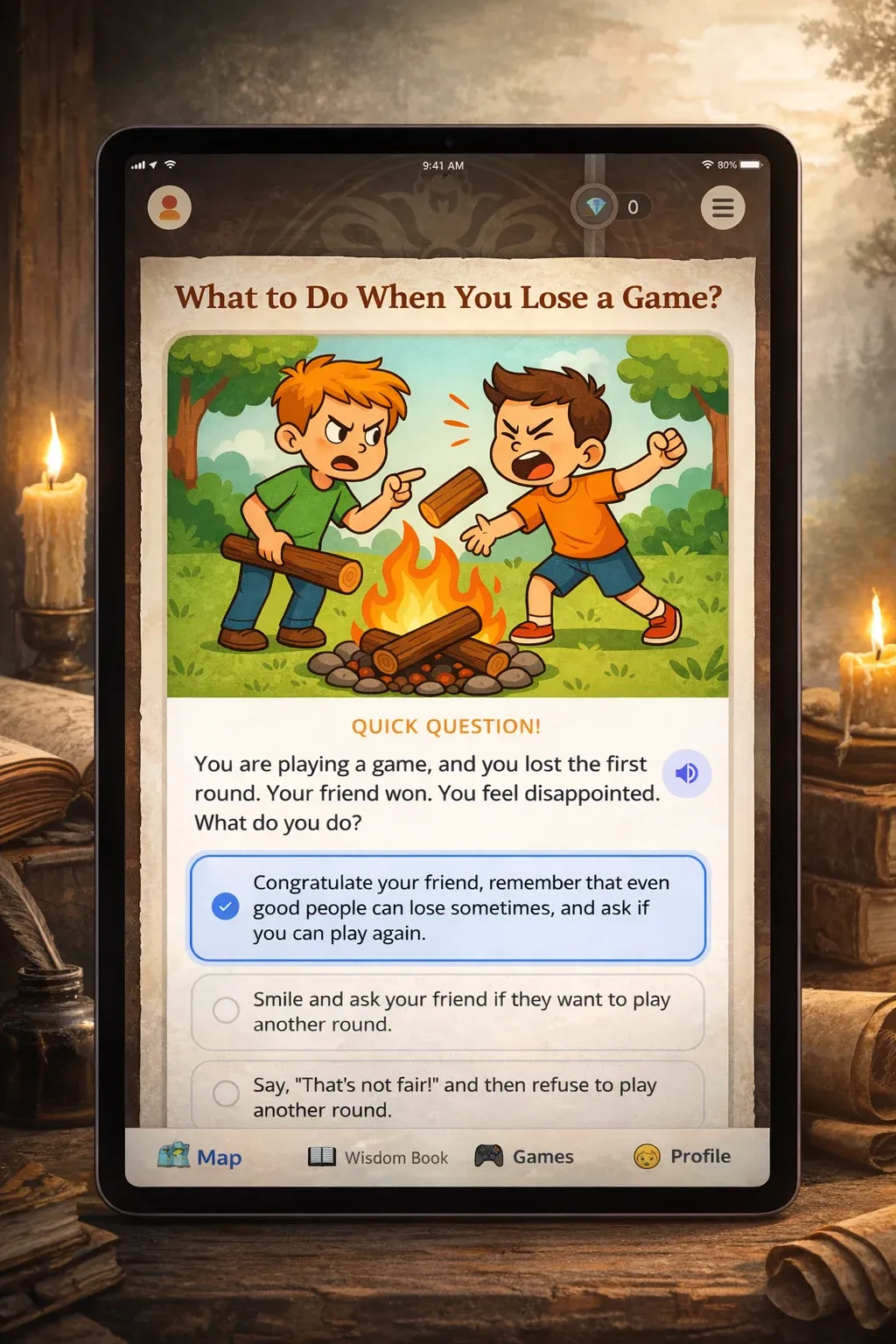
Most SEL platforms stop at surface-level mood tracking. They'll show you a dashboard full of "happy face" clicks and call it progress monitoring.
That's not measurement. That's wishful thinking.
Our voice-based AI mentor goes deeper through behavioral scenario questions: interactive situations that pop up during conversations where students must choose what they'd actually do in challenging social situations.
Here's how it works:
Your student is engaged in a story about friendship challenges. Suddenly, they face a choice: "Your friend just shared something embarrassing about another classmate. What do you do?"
Three options appear:
- Ideal response: "I'd tell my friend that sharing secrets isn't kind and suggest we talk about something else."
- Acceptable response: "I'd listen but not repeat what they said to anyone else."
- Not acceptable response: "I'd ask for more details because it sounds interesting."
This isn't a quiz: it's practice. Your students are building decision-making skills through realistic scenarios that mirror the social challenges they face every day.
The Scale Advantage: 200+ Students, One AI Mentor, Zero Burnout

Let's be honest about the math problem facing your school. You have hundreds of students who need individualized SEL support. You have a handful of counselors and teachers who are already stretched thin.
Traditional solutions don't scale:
- Human tutors: Expensive, limited availability, inconsistent quality
- Worksheets: Zero personalization, no real-time feedback
- Group programs: One-size-fits-all approach misses individual needs
Voice-based AI tutoring scales perfectly:
- Available 24/7 for students who need support outside school hours
- Consistent quality every single interaction
- Personalized to each student's specific challenges and interests
- Tracks progress through actual behavioral choices, not just feelings
Your AI mentor never gets tired, never has a bad day, and never runs out of patience with that student who needs extra support.
Real-Time Insights That Actually Help Teachers
You don't need another dashboard full of colorful charts that tell you nothing actionable. You need intelligent insights that help you support your students better.
When students interact with voice-based AI tutoring, you get:
- Conversation summaries highlighting specific social-emotional challenges
- Behavioral choice patterns showing growth in decision-making skills
- Intervention recommendations for students who need additional support
- Progress tracking through actual skill demonstration, not self-reported feelings
Example insight: "Marcus is showing consistent improvement in conflict resolution scenarios: he's moved from confrontational responses to collaborative solutions over the past month. However, he's still struggling with emotional regulation during peer pressure situations. Consider these targeted story modules..."
This is the kind of actionable intelligence that helps you make real differences in your students' lives.
The Conversation Revolution vs. The Worksheet Industrial Complex

Most SEL programs were designed in an era when "interactive" meant fill-in-the-blank worksheets and "personalized" meant putting the student's name at the top of the page.
The old way treats SEL like a subject to memorize:
- Read about empathy
- Define friendship in your own words
- Circle your feelings on a scale of 1-10
Voice-based AI treats SEL like a skill to practice:
- Have conversations about real challenges
- Make decisions in realistic scenarios
- Get immediate feedback and guidance
Your students don't need to read about social skills: they need to practice social skills in a safe, supportive environment that meets them exactly where they are.
Why Schools Choose Voice-Based AI Over Traditional SEL
Engagement: Students actually want to talk to their AI mentor instead of dreading another worksheet.
Authenticity: Real conversations reveal genuine challenges that surveys never capture.
Scalability: One AI mentor supports unlimited students with consistent, high-quality interactions.
Privacy: COPPA-compliant conversations provide safe spaces for vulnerable sharing.
Impact: Measurable behavior change through decision-making scenarios, not just mood tracking.
Ready to Give Your Students the 2 Sigma Advantage?
The research is clear: individualized tutoring creates transformational learning outcomes. Voice-based AI finally makes this level of personalized support possible for every student in your school.
Your students deserve more than emoji check-ins and worksheets. They deserve real conversations that build real character.
Ready to see voice-based AI tutoring in action? Get Early Access.
The future of social-emotional learning isn't about better worksheets. It's about better conversations.
And those conversations start today.